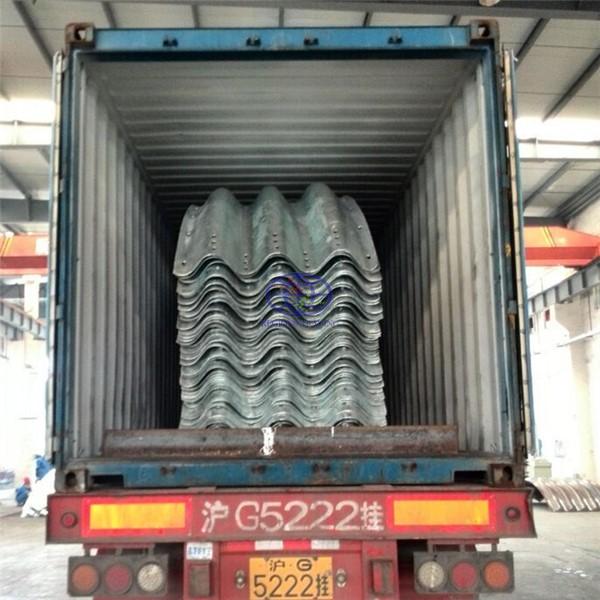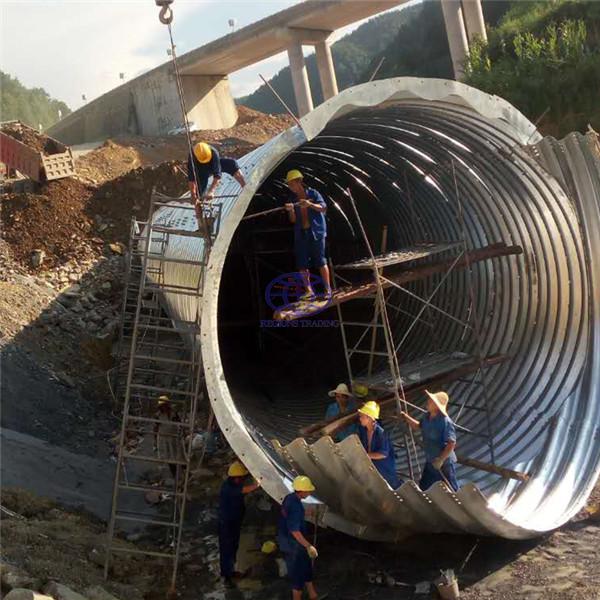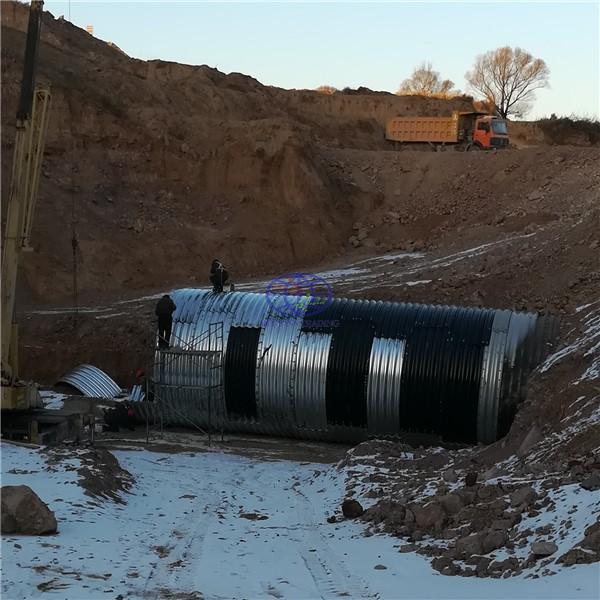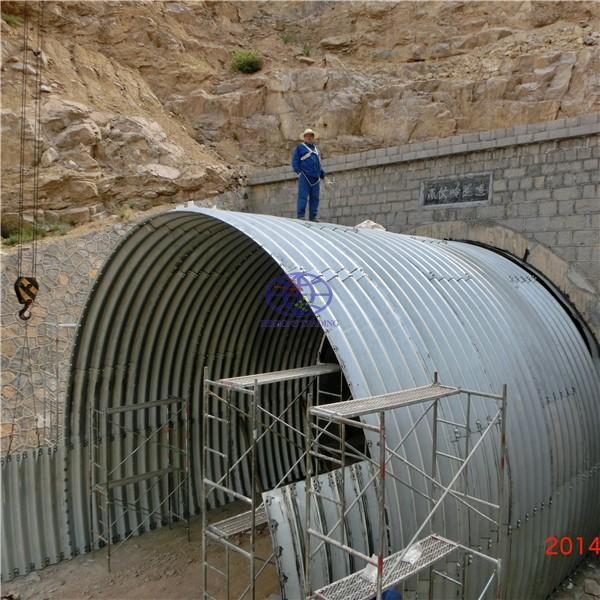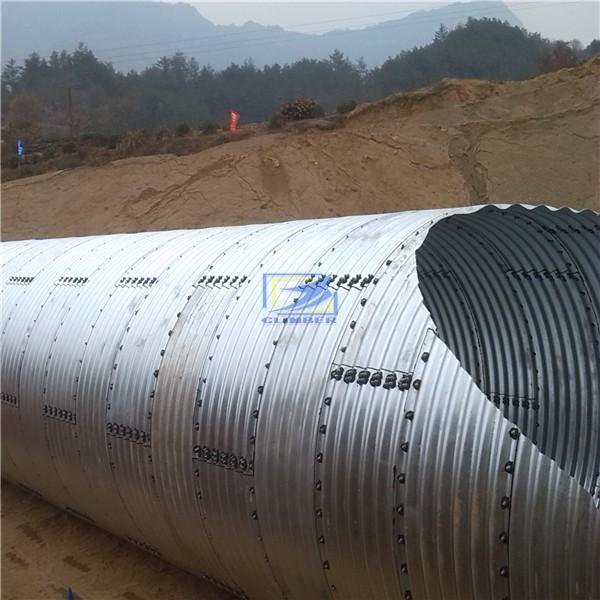
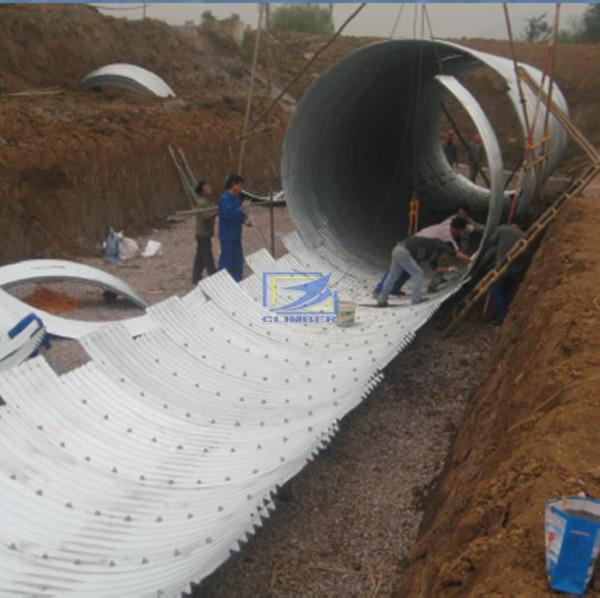
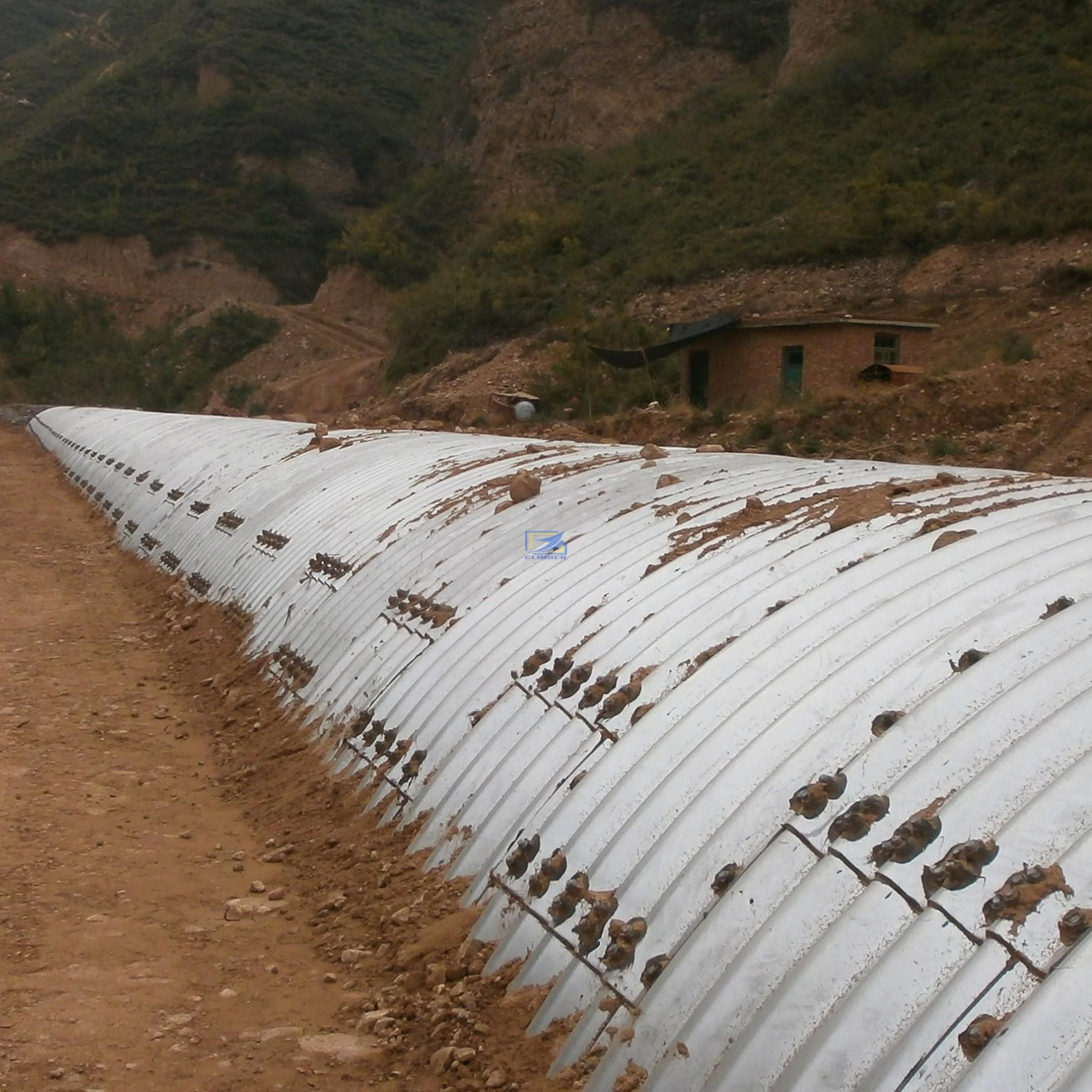
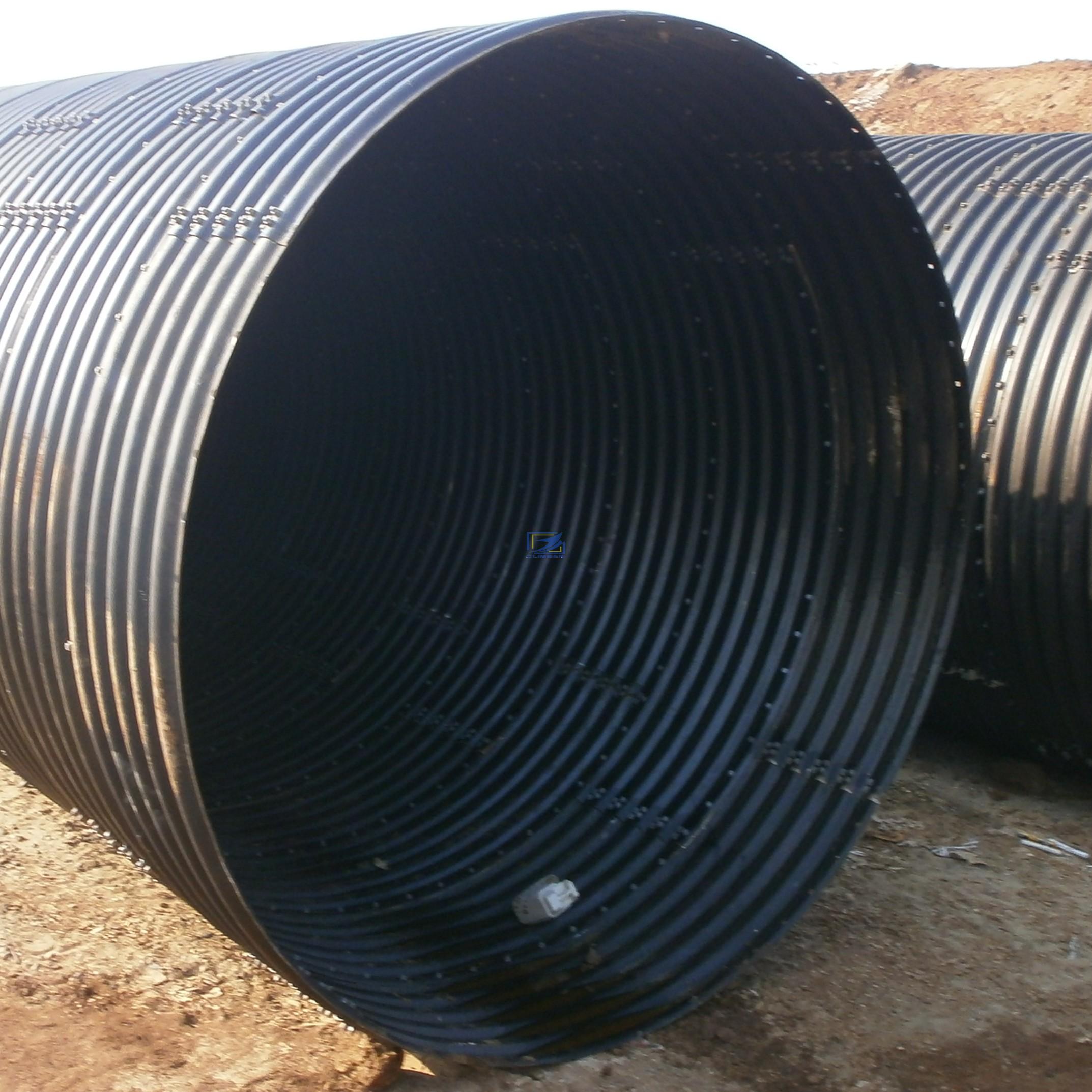
Corrugated metal culvert pipe is assembly by corrugated steel structural plate (SSP) which is shipped to the site in curved plates and field assembled into its final shape by bolting. When spans exceed 3meter, SSP quickly becomes the best corrugated steel option. Without shipment limitations associated with large conventional pipe, combined with increased thicknesses (through 1 gage) and stiffer corrugations, SSP expands the number of useful applications otherwise unattainable, and allows corrugated steel to be a viable alternative to the one or two options historically available in certain situations.
Specification
| Diameter (m) | The Thickness(mm)and correspondent Limited Filling height(m) | |||||||
| 3 | 4 | 5 | 6 | 7 | 8 | 9 | 10 | |
| 4 | 12.87 | 17.17 | 21.46 | 25.76 | 30.06 | 34.35 | 38.65 | 42.94 |
| 4.5 | 11.44 | 15.26 | 19.08 | 22.90 | 26.71 | 30.53 | 34.35 | 38.17 |
| 5 | 10.30 | 13.73 | 17.17 | 20.61 | 24.04 | 27.48 | 30.92 | 34.35 |
| 5.5 | 9.36 | 12.48 | 15.61 | 18.73 | 21.86 | 24.98 | 28.10 | 31.23 |
| 6 | 8.58 | 11.44 | 14.31 | 17.17 | 20.03 | 22.90 | 25.76 | 28.62 |
| 7 | 7.35 | 9.81 | 12.26 | 14.71 | 17.17 | 19.62 | 22.08 | 24.53 |
| 8 | 6.43 | 8.58 | 10.73 | 12.87 | 15.02 | 17.17 | 19.32 | 21.46 |
| 9 | 5.71 | 7.62 | 9.53 | 11.44 | 13.35 | 15.26 | 17.17 | 19.08 |
| 10 | 5.14 | 6.86 | 8.58 | 10.30 | 12.01 | 13.73 | 15.45 | 17.17 |
| 11 | 4.67 | 6.23 | 7.80 | 9.36 | 10.92 | 12.48 | 14.05 | 15.61 |
| 12 | 4.28 | 5.71 | 7.15 | 8.58 | 10.01 | 11.44 | 12.87 | 14.31 |
| 13 | 3.95 | 5.27 | 6.60 | 7.92 | 9.24 | 10.56 | 11.88 | 13.20 |
| 14 | 3.67 | 4.90 | 6.12 | 7.35 | 8.58 | 9.81 | 11.03 | 12.26 |
| 15 | 3.42 | 4.57 | 5.71 | 6.86 | 8.01 | 9.15 | 10.30 | 11.44 |
Why Structural Plate Culverts Are Gaining Popularity
Infrastructure owners increasingly prefer structural plate systems over cast-in-place concrete and conventional culverts. The reasons are both technical and economic.
1. No Transportation Size Limit
Traditional large pipes face shipping restrictions. Structural plate systems solve this problem because:
Plates ship flat or curved in bundles
Containers and standard trucks can be used
On-site assembly creates the final large diameter
This makes the big diameter corrugated metal culvert pipe assembled by structural plate ideal for remote or overseas projects.
2. Superior Structural Efficiency
Deep corrugations increase moment of inertia and stiffness. Compared with smooth-wall pipes:
Higher load-bearing capacity
Better resistance to soil pressure
Improved performance under deep fill conditions
When spans exceed 3 meters, structural plate quickly becomes the most economical steel option.
3. Faster Construction Time
Time savings are significant:
No curing time (unlike concrete)
Rapid bolted assembly
Minimal heavy equipment required
Suitable for staged construction
Projects using big diameter corrugated metal culvert pipe assembled by structural plate often reduce installation time by 30–60%.
4. Environmental Compatibility
One major advantage is ecological friendliness:
Arch shapes preserve natural streambeds
Wildlife can pass through easily
Reduced site disturbance
Minimal concrete usage
For environmentally sensitive crossings, structural plate culverts are often preferred by regulators.
Main Components of Structural Plate Culvert Systems
Understanding the system helps engineers specify correctly.
Corrugated Structural Steel Plates (SSP)
These are the primary load-bearing elements. Features include:
Deep corrugation profile
High-strength carbon steel
Precision punched bolt holes
Factory galvanization
High-Strength Bolts and Fasteners
Bolts ensure structural integrity:
Grade-controlled fasteners
Corrosion-resistant coating
Torque-controlled installation
Protective Coatings
Typical protection system:
Hot-dip galvanizing: 610–1200 g/m²
Optional bitumen coating during assembly
Extended service life in aggressive environments

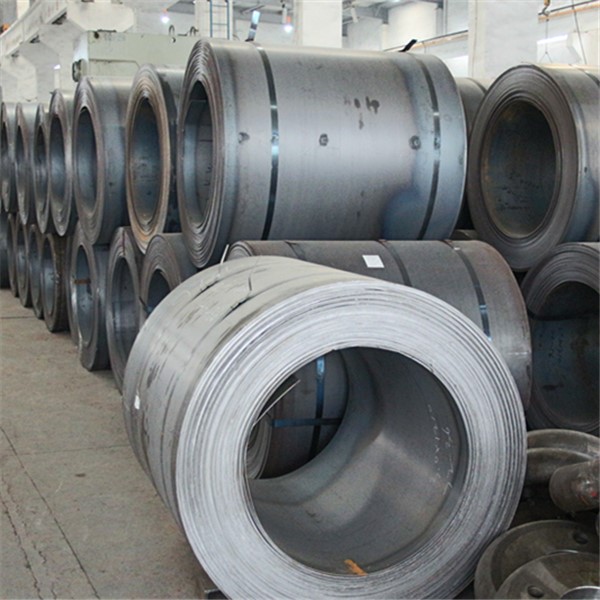
Our raw material of the corrugated steel culvert pipe
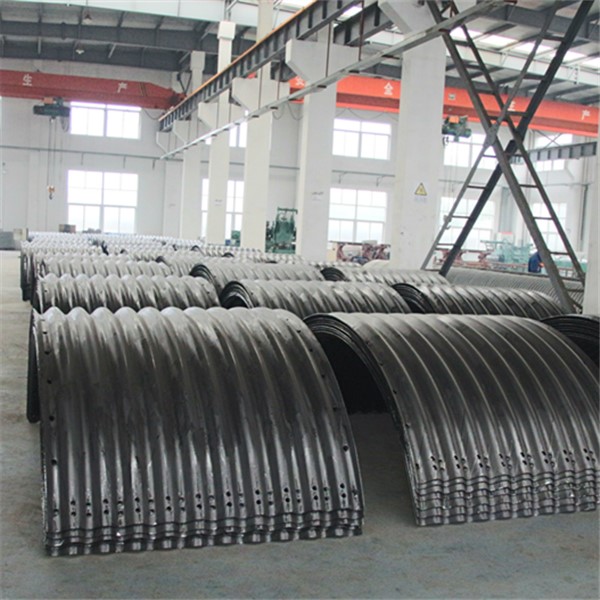
Our semi-finished corrugated steel culvert
Diameter and Thickness Design Guide
Structural plate culverts are highly customizable. The table below shows typical relationships between diameter, plate thickness, and allowable fill height.
Example Performance Overview
| Diameter (m) | Plate Thickness Range | Typical Max Fill Height |
|---|---|---|
| 4–6 m | 3–10 mm | Medium fill |
| 7–10 m | 4–10 mm | High fill |
| 11–15 m | 5–10 mm | Deep fill |
Engineering Note: Final design must consider:
Soil type
Compaction level
Live loads
Hydraulics
Foundation conditions
Professional structural calculations are recommended for every project.
Common Shapes Available
The big diameter corrugated metal culvert pipe assembled by structural plate is not limited to circular pipes. Multiple shapes improve hydraulic and structural performance.
1. Circular
Best for:
Storm sewers
Drainage systems
Pressure flow
2. Pipe Arch
Advantages:
Reduced excavation
Better waterway width
Lower cover requirements
3. Structural Plate Arch
Ideal for:
Wildlife crossings
Stream enclosures
Eco-friendly projects
4. Underpass and Box-Like Shapes
Used for:
Pedestrian crossings
Vehicle underpasses
Utility corridors
Major Application Scenarios
Structural plate culverts are extremely versatile.
Highway and Railway Culverts
The big diameter corrugated metal culvert pipe assembled by structural plate is widely used under roads and railways because it:
Handles heavy live loads
Installs quickly during traffic windows
Requires minimal maintenance
Storm Water and Drainage Systems
Municipal engineers favor these systems for:
Urban storm sewers
Flood control channels
Agricultural drainage
Small Bridges
When spans are moderate, structural plate bridges offer:
Lower cost than concrete bridges
Faster construction
Long service life
Stream Enclosures
Environmental projects benefit from:
Natural streambed preservation
Fish passage capability
Reduced ecological disruption
Mining and Industrial Access
Heavy-duty applications include:
Mine haul road crossings
Temporary detours
Industrial drainage
Installation Process Overview
Proper installation is critical to performance.
Step 1: Foundation Preparation
Key requirements:
Level bedding
Proper compaction
Suitable backfill material
Adequate drainage
Step 2: Plate Assembly
The big diameter corrugated metal culvert pipe assembled by structural plate is assembled on site:
Lay out plates
Align bolt holes
Insert and tighten bolts
Check geometry
Complete ring assembly
Step 3: Backfilling
Backfill quality directly affects structural performance.
Best practices:
Place in layers
Compact uniformly on both sides
Avoid large stones near the plate
Maintain symmetry
Step 4: Final Surface Protection
Optional steps:
Bitumen coating
Joint sealing
End treatment installation
Design Advantages Over Concrete Culverts
Many project owners compare steel structural plates with reinforced concrete.
Weight and Logistics
Steel structural plate:
Much lighter
Easier transport
Suitable for remote regions
Concrete:
Heavy
Requires special transport
Limited by casting size
Construction Speed
Steel structural plate:
Rapid assembly
No curing time
Weather-tolerant
Concrete:
Slow curing
Formwork required
Weather sensitive
Cost Efficiency
In many large-span cases, the big diameter corrugated metal culvert pipe assembled by structural plate provides:
Lower total installed cost
Reduced labor
Lower equipment needs
Maintenance
Galvanized steel systems offer long service life with minimal upkeep when properly designed.

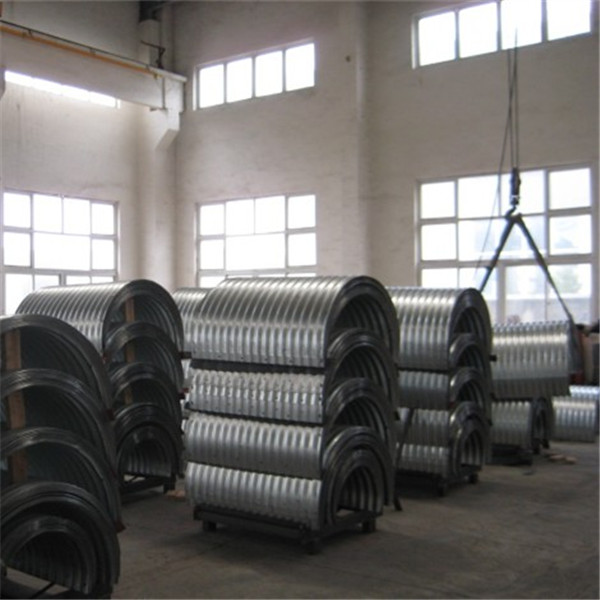
The corrugated steel culvert pipe in stock
Global Market Applications
Structural plate culverts have been successfully supplied to many regions, including:
Mongolia
India
Malaysia
Ethiopia
Kenya
Sudan
South Sudan
Australia
Papua New Guinea
Bolivia
These projects demonstrate the adaptability of the big diameter corrugated metal culvert pipe assembled by structural plate across different climates and soil conditions.
Production Capacity and Manufacturing Strength
Professional manufacturers typically maintain strong production capabilities.
Typical capabilities include:
Monthly supply around 1500 tons
Automated corrugation lines
Precision punching equipment
Strict quality control systems
Export-ready packaging
Reliable suppliers emphasize:
On-time delivery
Customized engineering
Full-process service support
Logistics and Overseas Delivery Advantages
One major strength of structural plate systems is export convenience.
Modular Shipping Benefits
Because the big diameter corrugated metal culvert pipe assembled by structural plate ships in sections:
Fits standard containers
Reduces freight cost
Avoids oversize cargo issues
Simplifies customs clearance
Flexible Delivery Options
Suppliers can typically offer:
FOB, CFR, CIF terms
Shipment to any major port
Door-to-door delivery in some countries
Installation guidance
This makes the system especially attractive for international contractors.
Quality Control and Standards
High-quality structural plate culverts follow strict controls.
Manufacturing Checks
Raw material inspection
Thickness verification
Galvanizing weight test
Bolt hole accuracy
Dimensional inspection
Performance Standards
Design commonly references:
AASHTO guidelines
ASTM material standards
EN steel equivalencies
Local highway specifications
Buyers should always request mill certificates and coating reports.
How to Choose the Right Structural Plate Culvert
Selecting the correct big diameter corrugated metal culvert pipe assembled by structural plate requires careful evaluation.
Key Selection Factors
Hydraulic requirements
Design flow
Waterway width
Headwater limits
Structural requirements
Fill height
Traffic load
Soil properties
Environmental conditions
Corrosion level
Soil resistivity
pH value
Abrasion risk
Project logistics
Site accessibility
Construction schedule
Budget constraints
Consulting with an experienced manufacturer during early design is highly recommended.
Maintenance and Service Life
When properly designed and installed, structural plate culverts offer long durability.
Typical Service Life
Standard galvanizing: 30–50 years
Heavy galvanizing + coating: 50–75+ years
With proper environment control: even longer
Maintenance Tips
Periodic visual inspection
Remove debris buildup
Monitor invert wear
Check joint tightness
Compared with concrete structures, maintenance is generally simpler and less costly.
Future Trends in Large Diameter Culvert Systems
The market for big diameter corrugated metal culvert pipe assembled by structural plate continues to grow due to:
Increasing infrastructure demand
Need for rapid construction
Emphasis on environmental protection
Rising transportation constraints
Cost pressure on public works
Emerging developments include:
Polymer-coated plates
Aluminum structural plates
Smart monitoring systems
BIM-integrated design
These innovations will further expand the application range.
Conclusion
The big diameter corrugated metal culvert pipe assembled by structural plate represents one of the most efficient and adaptable solutions for modern drainage and crossing projects. Its modular design eliminates transportation limits, while deep corrugations provide exceptional structural performance.
From highways and railways to eco-friendly stream crossings, this system offers clear advantages in speed, cost, and environmental compatibility. With high-quality materials such as Q235B and Q345B steel, heavy hot-dip galvanizing, and customizable configurations, structural plate culverts continue to replace traditional construction methods worldwide.
For engineers, contractors, and project owners seeking a reliable large-span solution, the big diameter corrugated metal culvert pipe assembled by structural plate remains a proven and forward-looking choice. Contact us for more information.
View more related products:
Supply the corrugated steel culvert to Cambodia